

Blockchain’s Growing Power Over Digital Identity Verified
Digital identity has always been a fragile thing. For decades, proving who you are online meant handing over sensitive personal data to centralized databases — the kind that get breached, sold, and exploited with alarming regularity. But something significant is shifting. Blockchain technology is quietly rewriting the rules of digital identity, and the implications stretch far beyond cryptocurrency wallets and NFT marketplaces.
From decentralized identifiers to verifiable credentials, the infrastructure for a more secure, user-controlled identity ecosystem is being built right now. Whether you’re a crypto enthusiast tracking the evolution of Web3 or someone concerned about data privacy, understanding how blockchain is reshaping digital identity is becoming increasingly essential.
How Does Digital Identity Work on Blockchain?
Traditional digital identity systems rely on third parties — governments, social media platforms, banks — to verify and store your identity data. You prove who you are, they hold the record, and you essentially trust them not to misuse it. The problem is that trust has been broken, repeatedly. Data breaches at Equifax, Facebook, and countless other organizations have exposed billions of people’s personal information.
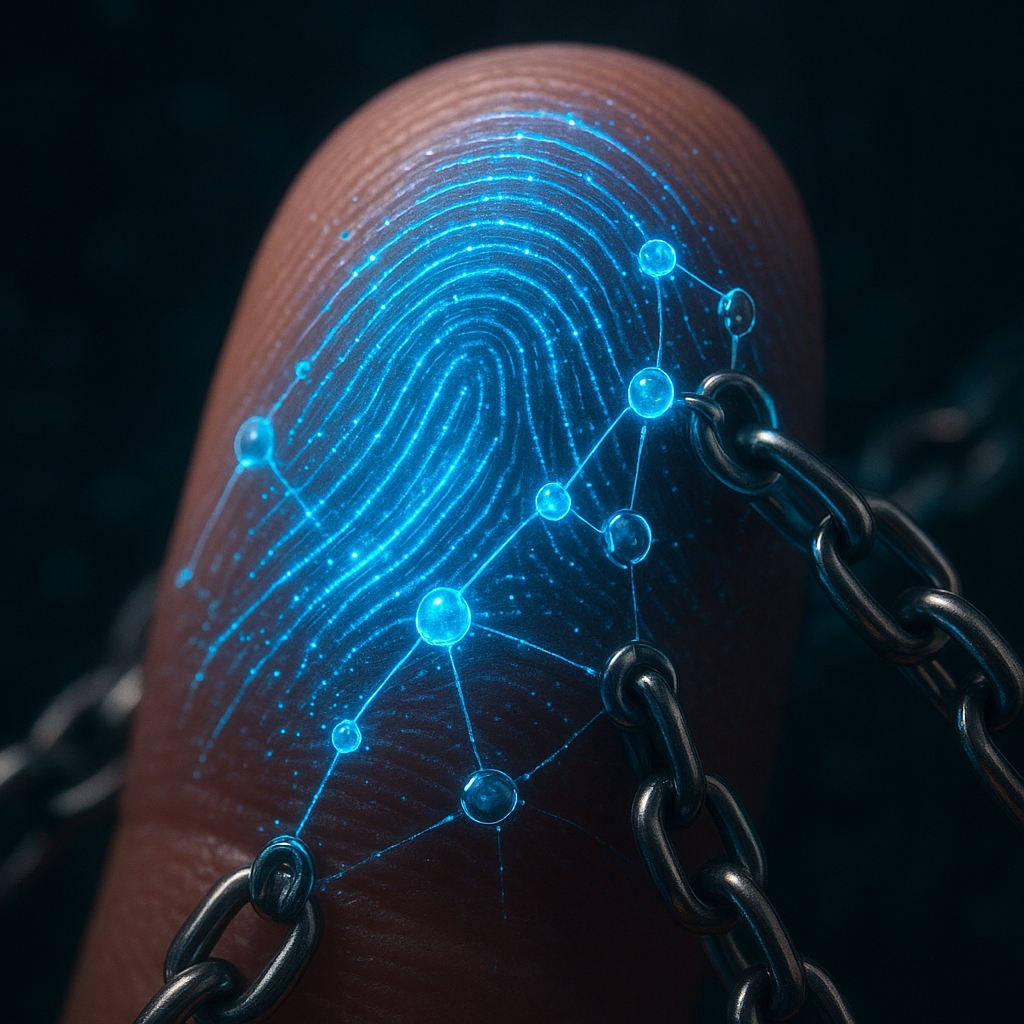
Blockchain-based digital identity flips this model on its head. Instead of your identity living in a company’s database, it lives on a distributed ledger that no single party controls. Here’s the core technical architecture:
Decentralized Identifiers (DIDs)
DIDs are a new type of identifier that enables verifiable, decentralized digital identity. They’re created and managed by the individual, not a third party, and they’re anchored to a blockchain. A DID looks something like a URL, but instead of pointing to a webpage, it points to a cryptographically secure identity document stored on-chain.
The World Wide Web Consortium (W3C) formalized the DID standard in 2022, which was a significant milestone. It means major technology providers are beginning to recognize this as a legitimate, scalable identity framework — not just a crypto experiment.
Verifiable Credentials (VCs)
Think of verifiable credentials as digital versions of physical documents — your driver’s license, university diploma, or medical certification. They’re issued by a trusted authority, held by the individual in a digital wallet, and can be verified by any third party without the issuer being involved in every transaction.
The critical difference from traditional documents is cryptographic proof. When a verifiable credential is presented, the verifier can confirm it’s authentic, unaltered, and issued by a legitimate party — all without calling up the issuing institution or querying a central database. This dramatically reduces friction while simultaneously improving security.
Self-Sovereign Identity (SSI)
The philosophical framework underpinning much of blockchain identity work is Self-Sovereign Identity, or SSI. The core idea is simple but radical: individuals should own and control their own identity data, deciding what to share, with whom, and for how long.
Under an SSI model, you might share your age verification for an online purchase without revealing your exact birthdate, home address, or any other information beyond what’s strictly necessary. This principle of selective disclosure is one of the most practically powerful aspects of blockchain-based identity systems.
What Is the Role of Blockchain in Identity Management?
Blockchain’s role isn’t just technical — it’s structural. The technology solves several long-standing problems in identity management simultaneously.
Eliminating Single Points of Failure
Centralized identity databases are honeypots for hackers. A single successful breach can compromise millions of records. Because blockchain distributes data across thousands of nodes, there’s no single server to target. Compromising one node doesn’t compromise the network, and the immutable nature of the ledger means tampering with records is computationally impractical.
Reducing Identity Fraud
Identity fraud costs the global economy hundreds of billions of dollars annually. According to the Federal Trade Commission, Americans alone reported losing over $10 billion to fraud in 2023, with identity theft being a major contributor. Blockchain-based verification systems make it significantly harder to fabricate or forge credentials because every credential is cryptographically signed and traceable to a verifiable issuer on-chain.
Streamlining KYC and Compliance
Know Your Customer (KYC) processes are notoriously expensive and repetitive. Every bank, exchange, and financial service requires its own verification process, meaning users re-submit the same documents dozens of times while companies spend enormous resources processing them. Blockchain identity systems allow a verified KYC credential to be issued once and reused across multiple platforms — dramatically reducing costs and user friction.
Major financial institutions and blockchain projects are already exploring this. Projects like Civic, Polygon ID, and the Decentralized Identity Foundation are building infrastructure that could eventually allow a single verified credential to satisfy compliance requirements across multiple jurisdictions and institutions.
Cross-Border Identity Verification
For the estimated 1 billion people worldwide who lack formal identification documents, blockchain identity systems present a genuinely transformative opportunity. Projects like the UN’s ID2020 initiative and the World Food Programme’s Building Blocks project have already demonstrated that blockchain-based identity can provide verifiable credentials to refugees and displaced populations who would otherwise have no way to prove their identity, access banking services, or receive aid efficiently.
Is Blockchain Still Relevant in 2025 and Beyond?
This is a fair question. After the hype cycles, the bear markets, and the high-profile collapses of various crypto projects, skepticism about blockchain’s long-term utility is understandable. But when it comes to identity management specifically, the technology’s relevance is actually increasing.
Here’s why:
- Regulatory pressure is growing: The EU’s eIDAS 2.0 regulation mandates that member states provide citizens with digital identity wallets by 2026. These wallets are designed around the very same verifiable credential and DID standards that blockchain identity projects have been developing for years.
- AI-generated deepfakes are creating a verification crisis: As synthetic media becomes indistinguishable from real footage, cryptographically verified identity becomes not a luxury but a necessity. Blockchain provides an audit trail that AI-generated content cannot replicate.
- Web3 adoption continues: Despite market volatility, the underlying infrastructure of decentralized applications continues to grow. Wallet-based identity is already standard in DeFi, DAOs, and NFT platforms — a foundation that’s gradually extending into mainstream use cases.
- Enterprise adoption is accelerating: Microsoft, IBM, and Accenture are all actively investing in blockchain identity solutions. Microsoft’s ION project, built on the Bitcoin network, has been operational since 2021 and is scaling its DID infrastructure.
The technology itself is also maturing. Layer 2 scaling solutions have addressed many of the speed and cost limitations that plagued early blockchain identity implementations. What was once theoretically interesting but practically cumbersome is becoming genuinely deployable at scale.
What Are the Biggest Challenges Facing Blockchain Identity?
Honest coverage requires acknowledging the obstacles. Blockchain identity isn’t a solved problem — it’s a rapidly evolving space with significant challenges still to overcome.
Interoperability
There are currently dozens of competing blockchain identity frameworks, each built on different standards and protocols. An identity credential issued on Ethereum doesn’t automatically work on Solana or Hyperledger Fabric. The lack of universal interoperability remains one of the most pressing technical hurdles. Organizations like the Decentralized Identity Foundation and the Trust Over IP Foundation are working on cross-chain standards, but full interoperability is still a work in progress.
Key Management and Recovery
If your blockchain identity is secured by a private key and you lose that key, recovery is extremely complicated — or in some cases, impossible. This is the same challenge that plagues crypto wallets generally. For mainstream adoption, user-friendly key recovery mechanisms need to mature significantly. Social recovery wallets and multi-party computation (MPC) are promising solutions, but they haven’t yet reached the simplicity required for non-technical users.

Regulatory Fragmentation
Different countries have wildly different approaches to digital identity and data sovereignty. What’s legally compliant in Germany may not satisfy requirements in the United States or Singapore. Building a globally interoperable identity system while satisfying local regulatory requirements is a genuinely complex legal and technical challenge.
User Adoption and Education
The average person doesn’t know what a DID is, and shouldn’t need to. For blockchain identity to achieve mainstream adoption, the technology needs to be completely invisible beneath user-friendly interfaces. The infrastructure can be blockchain-powered while the user experience feels as simple as a fingerprint scan or a password manager. Bridging that gap between technical sophistication and consumer simplicity is one of the defining design challenges of the next several years.
Zero-Knowledge Proofs: The Privacy Game-Changer
One of the most exciting developments in blockchain identity is the integration of zero-knowledge proofs (ZKPs). This cryptographic technique allows one party to prove to another that a statement is true without revealing any underlying information beyond the truth of that statement.
In practical identity terms, this means you can prove you’re over 21 without revealing your birthday, prove you’re a licensed professional without disclosing your license number, or prove you have sufficient funds for a transaction without revealing your account balance.
Projects like Polygon ID have built ZKP-based identity systems that operate entirely on-chain. Iden3 and zk-SNARKs technology are being integrated into enterprise identity solutions. This combination of blockchain’s immutability and ZKP’s privacy guarantees represents perhaps the most powerful privacy-preserving identity architecture ever developed.
Real-World Applications Already in Motion
This isn’t all theoretical. Blockchain identity solutions are actively deployed in several sectors:
- Healthcare: Patients controlling their own medical records and sharing them selectively with providers, reducing administrative overhead and improving care continuity.
- Education: Universities issuing tamper-proof digital diplomas on-chain. MIT has been issuing blockchain-based diplomas since 2017 through its Blockcerts initiative.
- Supply Chain: Workers and suppliers verified through blockchain credentials, reducing labor fraud and ensuring compliance with international standards.
- Financial Services: Crypto exchanges using decentralized KYC solutions to reduce compliance costs while improving verification accuracy.
- Voting: Pilot programs exploring blockchain-verified voter identity to reduce fraud while protecting ballot secrecy.
Conclusion
Blockchain’s growing power over digital identity isn’t hype — it’s an infrastructure shift that’s been building quietly for years and is now accelerating into mainstream relevance. The combination of decentralized identifiers, verifiable credentials, self-sovereign identity principles, and zero-knowledge proofs is creating a genuinely new paradigm for how identity works online.
The challenges are real: interoperability gaps, key management complexity, regulatory fragmentation, and the need for dramatically improved user experience all need to be addressed. But the direction of travel is clear. Regulatory frameworks like eIDAS 2.0 are mandating the adoption of these technologies. Enterprise investment is scaling. The privacy and security imperatives created by AI deepfakes and ongoing data breaches are making cryptographically verified identity not just desirable but necessary.
For anyone operating in the crypto and Web3 space, understanding blockchain identity isn’t optional knowledge — it’s foundational. The infrastructure being built today will determine how billions of people authenticate, transact, and prove their existence in the digital world for decades to come.
Comments are Disabled